You've probably seen the ads: "Full interior paint job, $1,200." Or the guy who drops off a handwritten estimate for half what everyone else quoted. It's tempting. But after 20+ years of painting homes in Seattle and Bellevue, we can tell you exactly what you're buying at each price point — and what you're giving up.
It's Almost Always About Prep
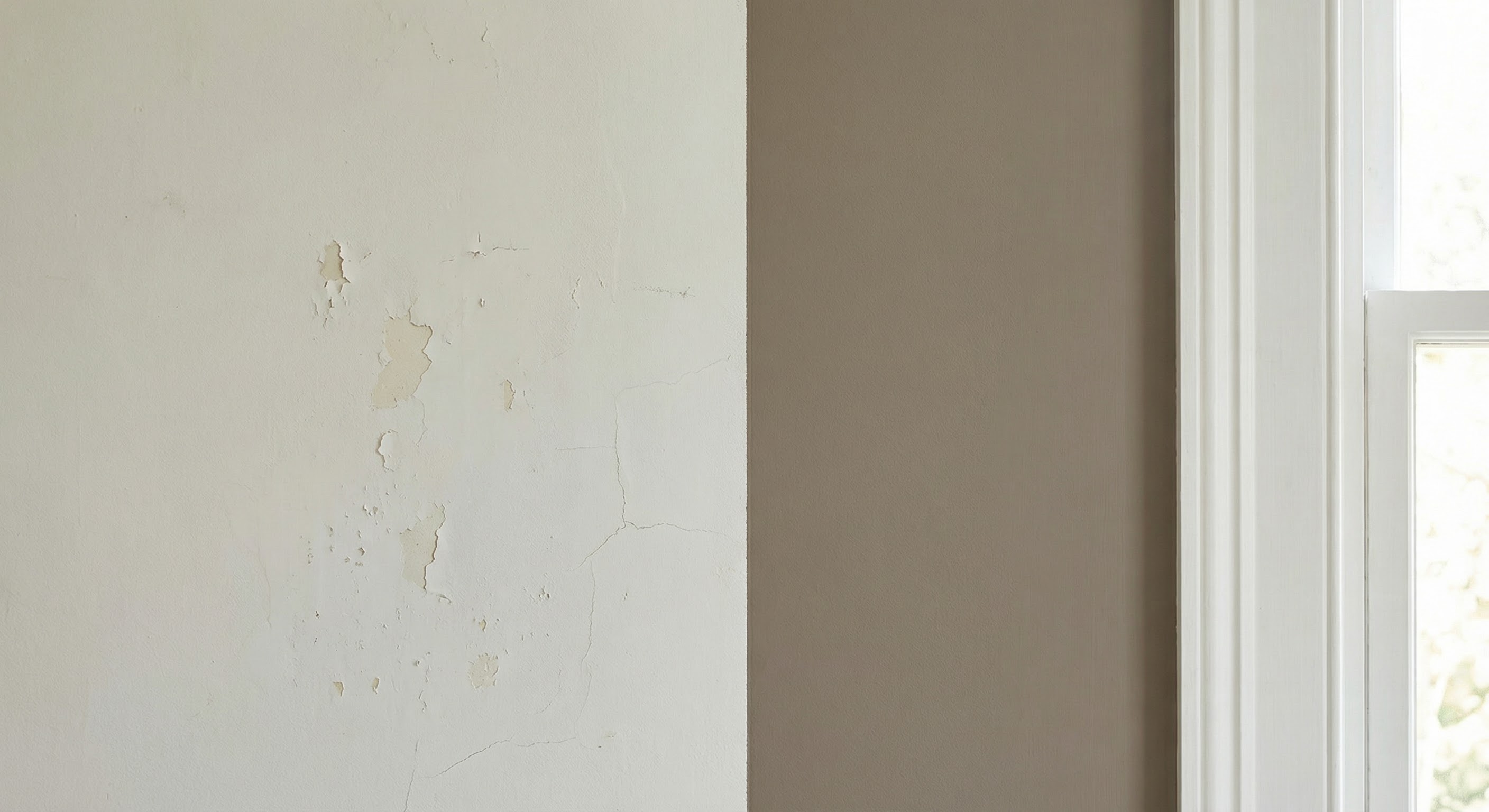
The most significant difference between a cheap paint job and a quality one has nothing to do with the paint itself. It's the prep work. Professional prep means washing walls, scraping loose paint, sanding surfaces, filling holes and cracks, caulking gaps around trim, and priming bare spots or stain-prone areas. This process takes time — in many cases, more time than the actual painting. Budget crews skip it almost entirely. They prime over problems, paint over patched areas without feathering, and leave details that a professional would never accept.
The result looks fine on day one. By year two, you're seeing cracking at the edges of patches, paint lifting around trim, and lap marks where corners were rushed. What looked like savings is now a second paint job.
Paint Quality Is Not a Small Difference
There's a significant performance gap between commodity paints and premium products. A budget gallon might cost $25–35. Sherwin-Williams Emerald, Benjamin Moore Aura, or Farrow & Ball run $80–$120 per gallon. That's not just marketing. Premium paints have higher pigment density (better color accuracy and hide), superior binders (better adhesion and flexibility), and added ingredients for washability, mold resistance, and durability. In practical terms: premium paint on a well-prepped wall can be wiped clean, resists scuffs, and maintains its sheen for years. Budget paint on a poorly-prepped wall shows wear within months.
At Vasy Painting, we use premium-grade paint on every project. Not as an upsell — as a standard. It's the only way we can stand behind our work.
Experience and Attention to Detail
Cutting in edges — painting a clean, sharp line where walls meet trim, ceilings, or adjacent colors — is a skill that takes years to develop. Budget crews often tape everything, which takes time and still leaves bleed. Experienced painters cut in freehand, faster and cleaner. You can tell the difference when you look closely at any edge in the room.
The same applies to rolling technique. Proper rolling requires consistent pressure, correct overlap, and the right nap thickness for the surface texture. Done wrong, you get roller texture variations, holiday spots (areas that were missed), and uneven sheen. Done right, the wall looks perfect from across the room and from six inches away.
What a Low Bid Actually Costs You
Here's the math: a $2,500 paint job that fails in three years and requires a $3,000 repaint has cost you $5,500. A $6,000 paint job done properly that lasts ten years costs $6,000. The premium job is cheaper. And for the first ten years, it looks dramatically better. In the Pacific Northwest's demanding climate, this difference is even more pronounced.
What to Look For When Getting Quotes
When comparing bids, don't just compare the bottom line. Ask what prep work is included. Ask what brand and product line of paint they're specifying. Ask whether they provide a workmanship warranty and for how long. A professional painter will answer those questions clearly and specifically. One who hedges or gets vague is likely planning to cut exactly those corners.
We've been doing premium painting work in the Seattle area since 2003. Every project gets the same level of prep, the same quality of materials, and the same attention to detail — whether it's a single room or a full custom home. If you're getting quotes, we'd be glad to be one of them.